MIYF History of the Royal Maces MIYF

[The history is a work in progress. It started from a change of command pamphlet from 1996 and a recent write-up from the official web page and a defunct Indy web page. Other cruise book accounts and first person recollections have been blended in. Please help if you can. Most aircraft carrier cruise books have a history of each squadron that deployed with the ship. If you have a cruise book from any of the VA/VFA-27 deployments, please copy/scan the description for our squadron and send it along. We can build the most comprehensive history from these and your memories. Last update 23 Dec 2009]

MIYFSquadron History

The Royal Maces of Attack Squadron 27 were commissioned September 1, 1967 by Commander G.T. Pappas while the majority of personnel were undergoing A-7A training with VA-122. On 5 January 1968, the squadron was officially detached from Commander, Fleet Air Alameda and reported to Carrier Air Wing 14. VA-27 was the third west coast squadron to operate the new Vought A-7A Corsair II from NAS Lemoore. In May of 1968, as the Vietnam conflict raged, the "Royal Maces" departed for their first combat deployment aboard USS CONSTELLATION (CVA-64). During a second combat cruise, aboard USS CONSTELLATION in August 1969, VA-27 flew over 2,500 combat sorties. VA-27 was the only squadron to bring back all the pilots on each of the first two combat cruises; we lost A/C, but always recovered the driver.

Attack Squadron 27 transitioned to the newer A-7E on 30 June 1970, and a year later the Royal Maces embarked on their third combat cruise aboard USS ENTERPRISE (CVAN-65). Squadron pilots amassed over 4,400 combat flight hours from the deck of the Big "E" and participated in over 1,500 air strikes without the loss of a single aircraft.

In July 1972, Attack Squadron 27 was awarded the annual Admiral C. Wade McClusky Trophy by the Chief of Naval Operations as the most outstanding Attack Squadron in the Navy. Additionally, the squadron received the Chief of Naval Safety Award for accident-free operations during that same period. The Royal Maces commenced their fourth combat deployment in September 1972 and completed the year by winning the coveted Battle Efficiency Pennant, making a clean sweep of every award for excellence in the Light Attack Community for 1972.

During their fourth deployment, again aboard the 'Big E', the Royal Maces played a major role in Operations Linebacker I & Linebacker II. VA-27 flew successful all out raids against the Hanoi and Haiphong target complexes to interdict the flow of supplies in that country and into South Vietnam which led to successful peace negotiations.

The squadron began its next deployment to the Western Pacific in September 1974 aboard CVAN-65. The Royal Maces flew surveillance missions as the military situation deteriorated in Vietnam and, on 29 and 30 April, flew escort for United States Marine Corps and United States Air Force helicopters during the evacuation of American and Vietnamese personnel as part of Operation FREQUENT WIND.

In 1979, the Royal Maces joined the USS CORAL SEA (CV-43). Their first deployment aboard the “Ageless Warrior” was marked by a 102 day line period in the Indian Ocean in support of the Iranian Hostage rescue operation. The Royal Maces made two more deployments aboard the USS Coral Sea, one was another WestPac/IO tour and the last one being an around the world cruise in 1983. In 1984 VA-27 joined Carrier Air Wing 15 and deployed aboard the USS CARL VINSON (CVN-70) for a 7 1/2 month Western Pacific cruise, which included a 107 day Indian Ocean line period. During the time period from January 1985 through June 1986, VA-27 was a true leader in Naval Aviation. During this time frame they were awarded the 1985 CNO Aviation Safety Award, were selected the first ever recipients of the CNO “Grampaw Pettibone” award for safety awareness through communication, and in August 1986 the Chargers were awarded the coveted COMNAVAIRPAC Battle Efficiency award for the second time their history.

In 1991, after 23 years in the A-7E, 14 deployments, thousands of combat hours and numerous unit awards, the Royal Maces transitioned to the F/A-18A Hornet and were officially re-designated the "Chargers" of Strike Fighter Squadron 27. VA-27 was the last A-7 squadron at NAS Lemoore to transition to the Hornet. In November 1992, VFA-27 deployed with Lot VIII Hornets aboard USS KITTY HAWK (CV-63) as part of the CVW 15 "Wolfpack" for a Western Pacific deployment. During December 1992, the "Chargers," operating off the coast of Somalia in support of Operation RESTORE HOPE, flew 2,500 miles to Dhahran, Saudi Arabia to augment United States Central Command's multi-national coalition Air Forces supporting Operation SOUTHERN WATCH. The squadron participated in a coalition night strike against Iraq on 13 January 1993, delivering over 18,000 pounds of ordnance on target.

In June 1994, the Chargers again deployed aboard the "HAWK" for Western Pacific deployment. Throughout the cruise, the Kitty Hawk Battle Group operated off the coasts of Japan and South Korea as a deterrent to possible North Korean aggression. By December 1994, the Chargers had completed their 16th Western Pacific cruise. Returning from cruise in December 1994, the squadron transitioned to Lot XII F/A 18C's and began preparations for a homeport change to Atsugi , Japan .

In 1995 the Chargers employed their new F/A 18C's during several Joint Training Exercises with Canada and the U.S. Air Force.

In 1996, VFA-27 commenced their homeport change to Atsugi , Japan . The Chargers culminated an intensive training period in May by firing six AIM-9L and 4 AIM-7M in a single day. In January 1996 the Chargers name was dropped and the squadron assumed its original designation as the Royal Maces. On June 4 1996, the newly re-designated "Royal Maces" flew all 12 squadron aircraft from Lemoore California to Atsugi , Japan to join the CVW-5/USS INDEPENDENCE (CV-62) "I-5" Team.

In 1997, the "Royal Maces" completed a year of travel and integration. The squadron participated in a number of joint operations while deployed on board USS INDEPENDENCE (CV-62). Some of the highlights included Operations TANDEM THRUST in Australia , FOAL EAGLE in Korea , and COPE NORTH in Japan . The "INDY" also made a historic trip to Guam . This port call marked the first time a U.S. carrier had visited Guam in over thirty years. Operating out of Naval Air Facility Atsugi the "Maces" detached to Kadena, Guam, Iwo Jima , and Misawa. The high tempo of operations in 1997 kept VFA-27 well prepared for their role as the "tip-of-the-spear."

1998 was a banner year for the "Royal Maces". Beginning in January, they began an emergency deployment to the Arabian Gulf in support of Operation SOUTHERN WATCH, and returned home to NAF Atsugi in June. After only 4 weeks at home the squadron once again boarded the ship to steam to the Island State of Hawaii to take the USS Independence on her final voyage home in preparation for her decommissioning. After participating in RIMPAC 98, the squadron and USS Independence made port in Pearl Harbor to begin the transfer of aircraft, material and personnel to the USS Kitty Hawk (CV-63). The Royal Maces and CVW5, now aboard the USS Kitty Hawk began their return journey to Yokosuka , Japan , arriving home the last week of August. Immediately the squadron completed several Major Inspection cycles and prepared once again for their fall deployment. Departing home in early October, the squadron deployed with the USS Kitty Hawk to South Korea and the northern coast of Japan to participate in FOAL EAGLE/COPE THUNDER/ANNUALEX 98 exercises. Returning in November, the command commenced a much needed and well-deserved standown. The year culminated with the squadron winning two major awards, the Pacific Fleet Battle Efficiency Award and the Admiral Wade McClusky Award. The Royal Maces truly distinguished themselves as the go-to squadron in the fleet.

In 1999, the squadron made preparations for its WESTPAC Spring deployment, departing Yokosuka in March, and once again the Hawk/Five team were called upon to sortie to the Arabian Gulf . During this 6-month deployment the squadron participated in flights over Iraq in support of Operation SOUTHERN WATCH and was called upon several times to perform retaliatory strikes. It was during this time period the "Royal Maces" successfully deployed and demonstrated the exceptional and unique capabilities of the Joint Stand Off Weapon (JSOW). Returning home in August, the squadron enjoyed a short stand down period and prepared for their fall deployment. Departing in September, the Hawk/Five team participated in FOAL EAGLE/COPE THUNDER/ANNUALEX 99 exercises, returning home in November.

In 2000, the "Royal Maces" began their spring deployment in March with a large detachment to Anderson Air Force Base in Guam for their Strike Fighter Advanced Readiness Program training. Boarding the Kitty Hawk in Guam, the second week of April, the squadron participated in TANDEM THRUST 2000 exercises and then made for port calls in Singapore and Pattaya Beach Thailand . After successful participation in the COBRA GOLD exercise with the government of Thailand , the squadron made a port of call to Hong Kong and returned home to NAF Atsugi in June. Departing in September, the Hawk/Five team participated in FOAL EAGLE/COPE THUNDER/ANNUALEX 2000 exercises, making port calls in Otaru , Japan and Pusan , Korea , finally returning home in November.

In the wake of the September 11, 2001 terrorist attacks, the squadron participated in Operation ENDURING FREEDOM flying missions against the Al Qaida infrastructure and Taliban forces in Afghanistan as well as protecting valued assets in Diego Garcia. In 2003, the Royal Maces continued the war on terror, flying hundreds of close air support and strike sorties against Iraqi forces in support of Operation IRAQI FREEDOM.

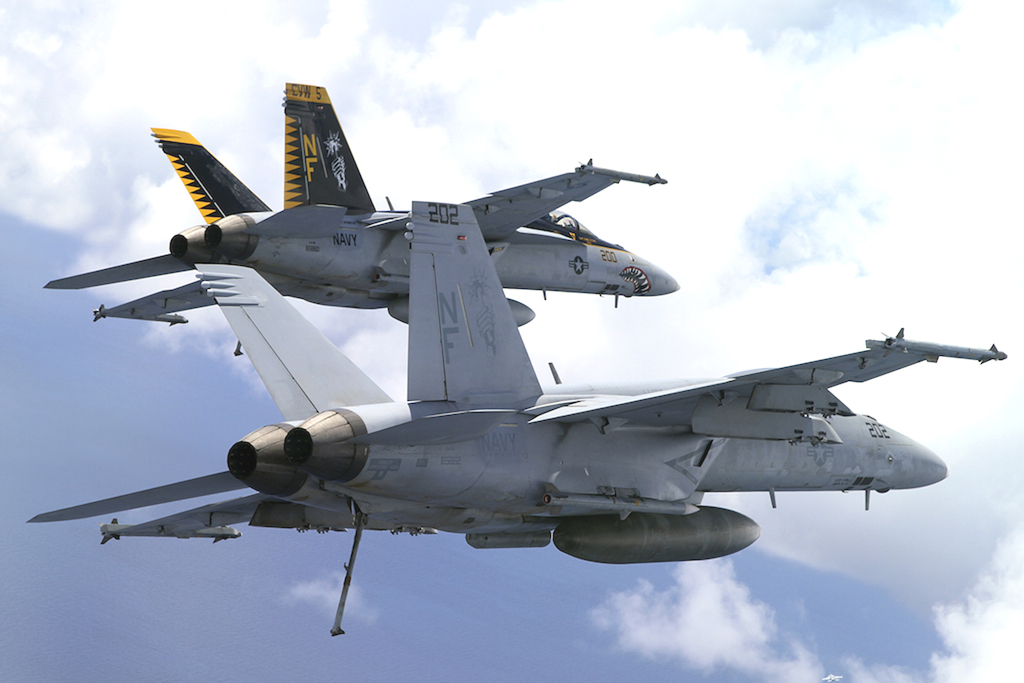
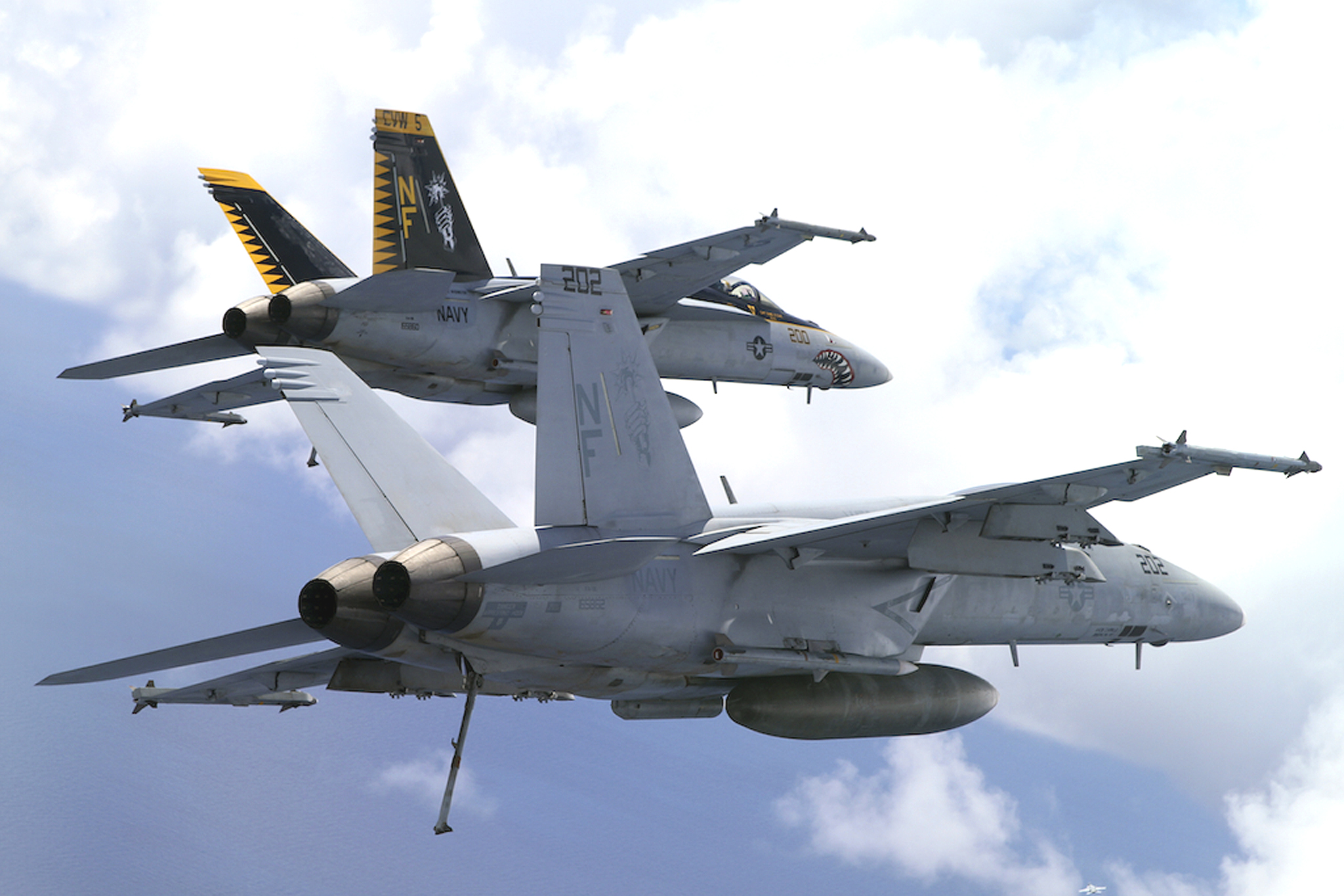
The Royal Maces of Strike Fighter Squadron 27 left USS Kitty Hawk in May 2004 to begin a transition from the F/A-18C Hornet to the F/A-18E/F Super Hornet. The squadron returned to CONUS for Super Hornet familiarization training. Enlisted Sailors attended the Naval Aviation Technical Training Unit in Lemoore, as well as other Super Hornet squadrons, for on-the-job training. Sailors learned about the new technology on the Super Hornets, such as the joint helmet mounted cueing system, part of the Super Hornet's new display system. VFA-27's pilots learned to fly and operate them with Fleet Replacement Squadron VFA-122. Like VFA-102 of the Kitty Hawk Strike Group, the squadron takes on the role of air-to-air refueling, or "tanking", while maintaining their primary mission as air-to-air and air-to-ground strike fighters. VFA-27 completed their transition to the F/A-18E Super Hornet in October 2004 at NAS Lemoore.

The Maces capped off a stellar 2005 by making a clean sweep of all aviation community awards including; Admiral Wade McClusky Award, Golden Anchor Award, Battle Efficiency and Safety Awards.

In 2006, the Royal Maces participated in Exercise Valiant Shield. Valiant Shield focuses on integrated joint training among U.S. military forces, enabling real-world proficiency in sustaining joint forces and in detecting, locating, tracking and engaging units at sea, in the air, on land and cyberspace in response to a range of mission areas.

August 2008 saw the Maces transition from their long time carrier Kitty Hawk CV-63 for their new assignment with CVW-5 aboard the USS George Washington CVN-73.

2009 started off with the Royal Maces being awarded their tenth CNO Safety "S" Award for outstanding safety in 2008.

MIYFLineage

Established as Attack Squadron TWENTY SEVEN (VA-27) on 1 September 1967. Redesignated Strike Fighter Squadron TWENTY SEVEN (VFA-27) on 24 January 1991.

MIYFSquadron Insignia and Nickname

The original squadron's insignia was approved by the CNO on 25 March 1968. Colors for the glove and mace insignia are as follows: sky blue background with a white cloud outlined in blue; light blue glove outlined in black and with USN in white; orange-red mace handle with a black mace, outlined in white; white scroll outlined in black with black lettering.

What is a Royal Mace:
The earliest Maces were hand held weapons designed to pierce heavy armor. Through their use by Royal Bodyguards in the fourteenth and fifteenth centuries, they came to symbolize authority. In the sixteenth century they became symbols of law and order widely used by cities and towns of Western Europe and Great Britain.

MIYFThe Origin of the VA/VFA-27 Royal Mace

"The design of the Royal Mace and the name came from the Senior Chief that was the plank owner QA Chief in the squadron and also quite an artist. I don't recall his name right now, but will get out a cruise book and look it up. He was a heavy smoker and was medically retired with emphysema after our first cruise.
The "saw tooth" rudder tail markings that were on the original aircraft, were the brain child of the line division officer, Bill Matto. He had a plane painted with them and showed the skipper. The skipper reamed him out for painting the planes without his permission and made Bill remove them. Then he told Bill to repaint them(now with his permission).
The name "Charger" was not devised with any great thoughts in mind. In those days you couldn't use your squadron name (Maces, Shrikes, etc) as your call sign, so you had to apply for one from the powers to be. I think we called up to COMFAIR Alameda and they said the name Charger was available. So we took that as our call sign."....Bud Biery

The Squadron name changes:

The official changes to the squadron name, nickname and call sign are hard to piece together. Some accounts state that when the squadron transitioned to the Hornet that the name changed to the Chargers.
Jay Bottorff writes: "I think it was about 1991 when the name change happened. I remember doing some research at Commander, Strike Fighter Wing Pacific (formerly COMLATWINGPAC) of all Hornet squadrons and kept seeing 27 referred as "Royal Maces" and the squadron called themselves "Chargers" - It was confusing. They also changed the color of the emblem from Blue background to Green and the glove became armor (with a "USN" on the lower end of it) instead of leather."
I have a write-up from an 85-86 cruise book that talks about the "Chargers accomplished this and that...etc..." So, was/is the Chargers the squadron call sign that got adopted as the official squadron name? It got switched back to the Royal Maces in 1996 according to Jay: "I got to the "Chargers" (as they were known ) in JAN 96 and I TRANS-PAC'ed them to Atsugi Japan. We had to change the squadron colors to Yellow/Black and assume the 2xx MODEX. The skipper, CDR "Phsyco" Ward also thought it was a good idea to change the patch and go back to being known as the "ROYAL MACES". (Eliminating the cloud but keeping the A-7E history...the shape of the new patch is the same as the "CORSAIR" patch.) I believe the call sign remained "Charger" throughout."

Official NameCall SignYears
Royal Maces Charger1968-1991
ChargersCharger1991-1996
Royal Maces Charger 1996-20xx
Royal Maces Mace 20xx-Present *** Need help to identify date when call sign changed to Mace

MIYFChronology of Significant Events

28 Jun 1968: The squadron flew its first combat sortie, striking targets in the panhandle region of North Vietnam.
4 Feb-7 Mar 1971: VA-27 embarked in Enterprise (CVAN 65), conducted training flights during the carrier's transit around Cape Horn to her new home port in California.
Dec 1971: With the outbreak of war between India and Pakistan over East Pakistan (later Bangladesh), Enterprise departed Yankee Station and made a quick transit to the Indian Ocean to provide support for the evacuation of foreign civilians from East Pakistan.
Oct 1972: Participated in Linebacker I operations, heavy air strikes against targets in North Vietnam to interdict the flow of supplies in that country and into South Vietnam.
Dec 1972: Participated in linebacker II operations, an intensified version of Linebacker I operations.
Feb 1975: Enterprise, with CVW-14, provided disaster support for the island country of Mauritius following a tropical storm.
Apr 1975: Participated in operation Frequent Wind and provided air support for helicopters evacuating personnel from Saigon as it fell to the communists.
Feb 1977: During the crisis in Uganda and threats against Americans in that country, Enterprise operated off the coast of Kenya for possible support in the evacuation of Americans.
Dec 1979: Coral Sea (CV 43) operated off the coast of South Korea following the assassination of South Korea's President Park Chung-Hee in late October.
Apr 1980: The squadron participated in the Iranian hostage rescue attempt by providing air cover for the forces directly involved in the rescue operation.
May 1980: Following civil unrest in South Korea, Coral Sea operated off the coast of that country.
Aug 1983: Due to the unsettled conditions in Central America, Coral Sea (CV 43) operated off the coast of Nicaragua.
Aug 1986: The squadron participated in the first carrier tactical flight operations in the Bering Sea since the end of World War II.
Jan 1996: VFA-27 Royal Maces TRANSPAC'd to NAF Atsugi, Japan as one of only two forward deployed Hornet squadrons.
Jan 1998: VFA-27 Royal Maces began an emergency deployment to the Arabian Gulf in support of Operation SOUTHERN WATCH.
Jan 2001: Operation ENDURING FREEDOM flying missions against the Al Qaida infrastructure and Taliban forces in Afghanistan.
Jan 2003: VFA-27 participates in Operation IRAQI FREEDOM, flying hundreds of close air support and strike sorties against Iraqi forces.
Oct 2004: VFA-27 transitioned to the F/A-18E Super Hornet.
Aug 2008: VFA-27 transitioned from USS Kitty Hawk to USS George Washington.

MIYFHome Port Assignments

LocationAssignment Date
NAS Lemoore0l Sep 1967
NAF Atsugi04 Jun 1996

MIYF Commanding Officers

Name/Rank Date Assumed Command
CDR George T. Pappas01 Sep 1967
CDR Donald L. Felt28 Feb 1969
CDR Thomas W. Durant04 Feb 1970
CDR Leroy B. Keely22 Jan1971
CDR Jerome L. Johnson22 Dec 1971
CDR Leon A. Edney15 Dec 1972
CDR Meredith W. Patrick09 Jan 1974
CDR James A. Kenney07 Mar 1975
CDR Dale A. Iverson28 May 1976
CDR Richard K. Pottratz01 Aug 1977
CDR James W. Partington30 Nov 1978
CDR James S. Zayicek10 May 1980
CDR Dennis V. McGinn24 Sep 1981
CDR Joseph F. Hart16 Dec 1982
CDR Hugh D. Connell II01 May 1984
CDR Joseph P. Sciabarra25 Oct 1985
CDR Malcolm P. Branch29 May 1987
CDR Richard F. Clayton03 Sep 1988
CDR Stanford H. Hlavka29 Mar 1990
CDR Don P. Davis August 1991
CDR T.N. Vaughn 28 Sep 1992
CDR Danny Knutson 10 Jan 1994
CDR Jim Ward 23 May 1995
CDR Vincient ShortsJun 1996
CDR Garry R. Mace Oct 1997
CDR Kevin C. Hutcheson Jan 1999
CDR Robert P. McLaughlin Jr.12 May 2000
CDR David B. Emich August 2001
CDR Gary Shoman 29 Aug 2002
CDR James Bynum 29 Aug 2003
CDR Kevin Mannix 03 Mar 2005
CDR Daniel Dwyer 25 May 2006
CDR Gregory C. Huffman 04 Aug 2007
CDR Gordon A. Cross 01 Sep 2008
CDR Fitzugh Lee 09 Dec 2009
CDR Steve Barr 16 Mar 2011

MIYF Aircraft Assignments

Type of AircraftDate Type First Received
A-7A Corsair II 05 Jan 1968
A-7E Corsair II 30 Jun 1970
F/A-18A Hornet 20 Feb 1991
F/A-18C Hornet Jan 1995
F/A-18E Super Hornet Oct 2004

MIYF Major Overseas Deployments

DepartureReturn Air WingCarrier AircraftMODEX Location
28 May 19683l Jan 1969 CVW-14CVA-64 A-7A
6xx
WestPac/Vietnam
11 Aug 196908 May 1970 CVW-14CVA-64 A-7A
4xx
WestPac/Vietnam
11 Jun 197112 Feb 1972 CVW-14CVAN-65 A-7E
4xx
WestPac/Vietnam/IO
12 Sep 197211 Jun 1973 CVW-14CVAN-65 A-7E
4xx
WestPac/Vietnam
17 Sep 197420 May 1975 CVW-14CVAN-65 A-7E
4xx
WestPac/IO
30 Jul 197628 Mar 1977 CVW-14CVN-65 A-7E
4xx
WestPac/IO
04 Apr 197830 Oct 1978 CVW-14CVN-65 A-7E
4xx
WestPac/IO
13 Nov 197911 Jun 1980 CVW-14CV-43 A-7E
4xx
WestPac/IO
20 Aug 198125 Mar 1982 CVW-14CV-43 A-7E
4xx
WestPac/IO
21 Mar 198312 Sep 1983 CVW-14CV-43 A-7E
4xx
World Cruise
13 Oct 198424 May 1985 CVW-15CVN-70 A-7E
4xx
WestPac/IO
12 Aug 198605 Feb 1987 CVW-15CVN-70 A-7E
4xx
WestPac/IO
15 Jun 198814 Dec 1988 CVW-15CVN-70 A-7E
4xx
WestPac/IO
05 Sep 198909 Nov 1989 CVW-15CVN-70 A-7E
4xx
NorPac/WestPac
01 Feb 199029 Jul 1990 CVW-15CVN-70 A-7E
4xx
WestPac/IO
01 Apr 199111 Dec 1991 CVW-15CV-63 F/A-18A
4xx
WestPac/IO
03 Dec 199203 May 1993 CVW-15CV-63 F/A-18A
4xx
WestPac/IO/Persian Gulf
24 Jun 199422 Dec 1994 CVW-15CV-63 F/A-18A
4xx
WestPac/IO
Jun 1996Jun 1998 CVW-5CV-62 F/A-18C
2xx
Forward Deployed/NAF Atsugi
Aug 1998 Aug 2004 CVW-5 CV-63 F/A-18C
2xx
Forward Deployed/NAF Atsugi
Aug 2004 7 Aug 2008 CVW-5CV-63 F/A-18E
2xx
Forward Deployed/NAF Atsugi
21 Aug 2008 Present CVW-5CVN-73 F/A-18E
2xx
Forward Deployed/NAF Atsugi

MIYF Air Wing Assignments

Air WingTail CodeAssignment Date
COMFAIRALAMEDA 01 Sep 1967
CVW-14NK05 Jan 1968
CVW-15NL21 Nov 1983
CVW-5NFJun 1996

MIYF  Back to Top  MIYF  Home Page  MIYF


!!!!!!!!!! Help !!!!!!!!!!
I need YOUR help to make this site great. I need any stories, photo's or information that you have on the Royal Maces. I can scan photo's for you if you don't have a scanner, email me for details. Please donate your memories so all Royal Maces and their family's can enjoy this site to its fullest. Also let me know if anything you see here is in error. Thanks!!!

Contact me, Bob Dorais, at: bob@miyf27.com
Site Launched March 7, 2000